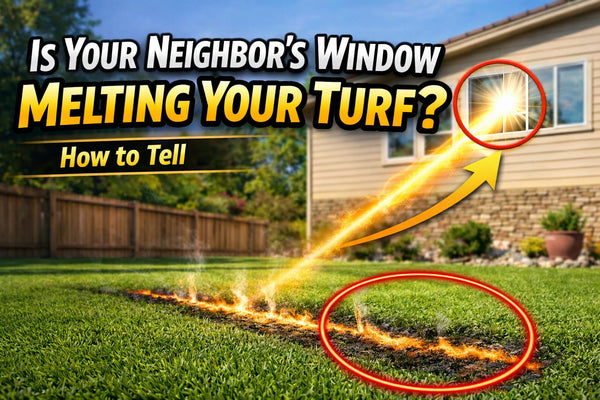
When artificial turf starts melting or you notice hot spots on siding, car trim, or patio items, the first solution most homeowners search for is exterior Turf-Guard Window Film. This film is designed to stop intense window glare caused by Low-E windows, especially those that create the concave “magnifying-glass” effect.
Many people wonder whether installing this film themselves is realistic, or if it’s one of those projects where hiring a professional is the best long-term move. This guide breaks down how DIY installation works, the tools you need, what commonly goes wrong, and when you should call a pro.

Does DIY exterior Turf-Guard Window Film actually work? Yes!
Exterior Turf-Guard Window Film works when installed by homeowners, but there are a few things to keep in mind:
-
Outside-applied films face heat, rain, wind, and dust.
-
Misalignment or trapped debris reduces performance.
-
Poor prep leads to bubbling, lifting, or early peeling.
DIY vs. Professional Installation: What You Need to Know
DIY Advantages
-
Lower cost
-
Fast, can do it the same day
DIY Disadvantages
-
Dirt, wind, bugs, and dust can complicate installation
-
Shorter lifespan if the glass isn’t prepped correctly, for example, glass isn’t cleaned
Professional Advantages
-
Done by a professional
-
May come with workmanship assurance or warranty
-
Accustomed to going up and down ladders (for second-story installs—often the point where DIY becomes unrealistic)
![windows are burning artificial turf]()

Exterior vs. Interior Film: Why Only Films that are Applied Outside Work
A key part of deciding whether to DIY or call a pro is understanding that interior window tint does NOT solve turf burn.
Why? Because Low-E coatings are on the inside of the dual-pane glass. Interior tint does nothing to disrupt the external reflection causing the hot spot.
Only outside-applied Turf-Guard Window Film can:
-
Break up mirror-like glare
-
Diffuse the reflected beam
-
Prevent the parabolic/magnifying-glass effect
-
Stop turf burn, melted siding, and hot-spot damage
If a product goes inside, it won’t help. DIY installers sometimes learn this the expensive way.
Tools You Need to Install Turf-Guard Window Film yourself:
-
Water
-
Paper towels
-
Squeegee
- Utility knife
Turf-Guard Window Film will include
-
Squeegee
-
Utility knife
-
Instructions
How to Install Turf-Guard Window Film (Step-by-Step)
-
Clean the window thoroughly
Remove dust, pollen, and debris. -
Measure and cut the film
Leave 1–2 inches of extra film around the edges. -
Spray the glass heavily with slip solution
This helps you reposition the film. -
Peel the liner and apply the film
Work in shade or early morning; hot glass makes the process much harder. -
Squeegee from the center outward
Use firm, overlapping strokes. This step determines whether the film bonds correctly. -
Trim the edges
Leave a clean 1/8" border for expansion and contraction. -
Final squeegee pass
Push out any remaining moisture or air. -
Let it cure
Do not touch or wash the window for at least 48–72 hours.
Common DIY Mistakes That Make the Film Fail Early
-
Applying film to hot glass
- Applying film on the interior
-
Not cleaning off tiny debris or sand
-
Installing in windy or dusty conditions
-
Crooked alignment
-
Over-trimming, which causes peeling
-
Not pressing out moisture fully
These issues lead to lifted corners, early peeling, trapped dirt, or a distorted look.
How Long Does Turf-Guard Window Film Last?
Turf Guard Window Film is built to endure harsh exterior conditions. It will last anywhere from 1-3 years, most likely more depending on conditions.
Lifespan depends heavily on:
-
Sun angle
-
Daily temperatures
-
Wind exposure
-
Reflective intensity of the window
Final Takeaway:
Turf-Guard Window Film is one of the easiest and most affordable DIY fixes for stopping window glare before it melts turf, siding, or outdoor plastics. If your windows are ground-level, DIY is a great option that can save hundreds of dollars.
But if the problem window is on a second story, requires a tall ladder, or feels unsafe to reach, hiring a professional installer is often the best choice.
Whether you DIY or hire it out, the goal is the same:
Stop the glare at the window, and you stop the turf burn for good.